


For AIFs subject to the annual PPM compliance audit, 30 September 2026 is the reporting deadline for FY 2025-26. This guide covers audit applicability, exemptions and the key considerations for fund teams preparing for the deadline.

Tanupreet Kaur
Sep 28, 2026
-
8
min to read

For AIFs that are subject to the annual audit of compliance with the terms of their Private Placement Memorandum, 30 September 2026 is the reporting deadline for FY 2025-26.
SEBI requires applicable AIFs to undergo an annual audit of compliance with their PPM terms. The audit findings, along with corrective steps, if any, must be communicated to the relevant governing body of the AIF, the governing body of its Manager, and SEBI within six months from the end of the financial year. PPM audit reports are submitted to SEBI through the SEBI Intermediary Portal, or SI Portal, in the prescribed reporting format.
Since FY 2025-26 ended on 31 March 2026, the six-month period ends on 30 September 2026.
But the first question for a fund team is not how to prepare for the audit. It is whether the audit requirement applies to the AIF or scheme in the first place. SEBI's framework contains several exemptions, and each has its own test.
A PPM audit tests whether an AIF complied with the terms of its Private Placement Memorandum during the relevant financial year.
SEBI permits the audit to be carried out by an internal auditor, external auditor or legal professional.
This goes beyond checking whether the PPM itself contains the required disclosures. The review compares the terms stated in the PPM with the fund's conduct during the year.
The exact work depends on the PPM. It may involve reviewing investment activity, investor commitments and contributions, capital calls and distributions, fees and expenses, approvals, conflicts, investor consents, valuation or reporting obligations, and amendments made during the year.
SEBI requires the findings of the annual PPM compliance audit, together with corrective steps, if any, to be communicated within six months from financial year-end to the Trustee, Board of Directors or Designated Partners of the AIF, as applicable; the Board of Directors or Designated Partners of the Manager, as applicable; and SEBI.
The PPM audit report must also be submitted online through the SI Portal using the applicable standard reporting format.
For that reason, PPM audit reporting deadline is more precise than simply calling 30 September the audit deadline.
No.
SEBI's current framework provides different exemptions depending on the type and status of the AIF or scheme. These exemptions should be tested separately.
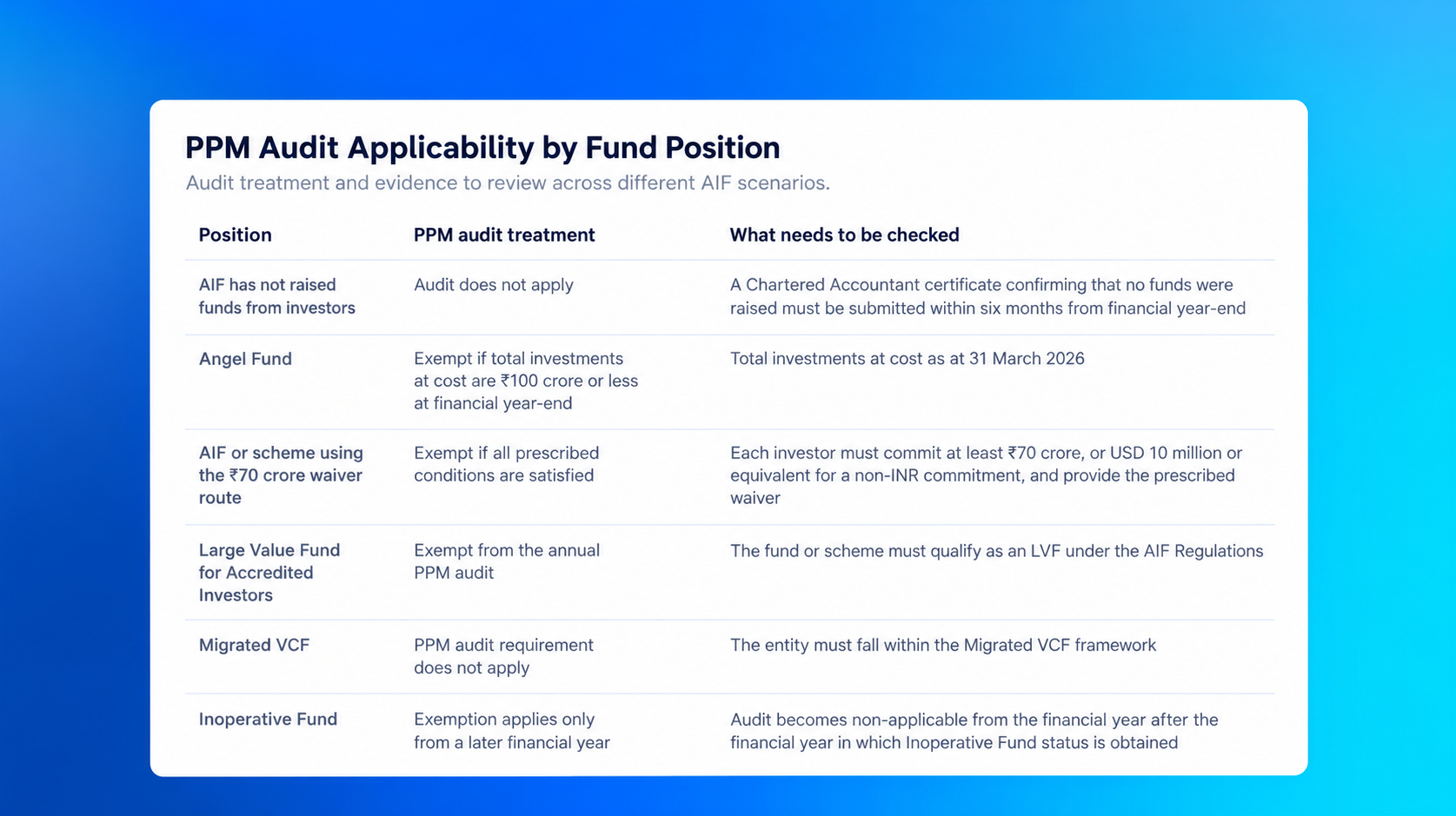
Audit becomes non-applicable from the financial year after the financial year in which Inoperative Fund status is obtained
The last row is particularly important for FY 2025-26. The Inoperative Fund framework was introduced in June 2026, after FY 2025-26 had ended. It therefore does not provide a basis for avoiding the FY 2025-26 PPM audit.
An AIF that has not raised funds from investors is not required to undergo the annual PPM compliance audit.
There is still a filing requirement. The AIF must submit a certificate from a Chartered Accountant confirming that no funds were raised, within six months from the end of the financial year.
For FY 2025-26, that six-month period ends on 30 September 2026.
For Angel Funds, the test is based on total investments at cost at the end of the financial year.
An Angel Fund with total investments at cost of ₹100 crore or less at financial year-end is exempt. If total investments at cost exceed ₹100 crore, the annual PPM audit requirement applies. SEBI made this requirement applicable to Angel Funds from FY 2025-26 onwards.
For the FY 2025-26 assessment, the relevant figure is therefore the Angel Fund's total investments at cost as at 31 March 2026.
This is not an AUM, corpus, commitment or capital-raised test. Using the wrong measure could lead to the wrong conclusion on applicability.
SEBI's September 7, 2026 circular gave Angel Funds additional time in relation to the Accredited Investor mandate. It does not replace the ₹100 crore PPM audit test described above.
SEBI provides a separate exemption for an AIF or scheme where each investor commits to a minimum capital contribution of ₹70 crore, or USD 10 million or equivalent where the commitment is denominated in a non-INR currency, and also provides the prescribed waiver from the annual PPM audit.
The waiver is given in the manner set out in Annexure 3 of the AIF Master Circular.
Both parts matter. A large commitment by itself is not enough, and the ₹70 crore threshold is tested per investor, not against the aggregate size of the fund.
A manager relying on this route should therefore be able to support both the qualifying commitment of each investor and the required waiver documentation.
Yes.
SEBI exempts Large Value Funds for Accredited Investors, or LVFs, from the annual PPM audit without requiring a separate PPM audit waiver from investors.
This exemption should not be confused with the separate ₹70 crore waiver route.
Under the current framework, an LVF is an AIF or scheme in which each investor, other than the specified Manager, Sponsor, employee and director categories excluded by the definition, is an Accredited Investor and invests at least ₹25 crore. The threshold was reduced from ₹70 crore under the regulatory changes introduced in November 2025.
The two amounts therefore serve different purposes.
₹25 crore is the current minimum investment threshold used in determining whether an eligible investor meets the LVF definition.
₹70 crore, or USD 10 million equivalent for a non-INR commitment, belongs to the separate PPM audit exemption that requires the prescribed waiver from each investor.
Keeping those tests separate is important when documenting why an audit exemption applies.
SEBI introduced the Inoperative Fund framework in June 2026 for eligible AIFs progressing towards surrender of registration after active fund management has ended.
For an AIF tagged as an Inoperative Fund, the PPM audit requirement becomes non-applicable from the financial year following the financial year in which the AIF receives Inoperative Fund status.
That timing means Inoperative Fund status cannot remove the FY 2025-26 PPM audit requirement.
For example, if an AIF receives Inoperative Fund status during FY 2026-27, the PPM audit exemption starts from FY 2027-28. The treatment does not apply retrospectively to FY 2025-26.
SEBI treats Venture Capital Funds that migrated from the erstwhile VCF framework to the AIF framework separately.
Under Annexure 20 of the current AIF Master Circular, the Chapter 21 provision dealing with audit of terms of the PPM is not applicable to Migrated VCFs.
A manager dealing with a migrated structure should therefore apply the specific Migrated VCF framework rather than assuming that the standard PPM audit requirement applies.
For a Co-Investment Vehicle, or CIV, scheme, the audit should be read in the context of the CIV's shelf PPM and the PPM of the main AIF scheme to which it relates.
SEBI's CIV framework allows the Manager to use a shelf placement memorandum for CIV schemes. Some information may be set out in, or linked back to, the PPM of the main scheme rather than repeated in full for each CIV.
This can affect how the standard PPM audit format is completed. Some questions in the format may not apply to a CIV because the corresponding disclosure or requirement is not relevant to that structure. In such cases, the response should be recorded as Not Applicable, with a short explanation of why the item does not apply and, where relevant, a reference to the shelf PPM or the main scheme PPM.
SEBI has not prescribed a separate PPM audit format specifically for CIV schemes. The applicable standard format therefore needs to be completed based on the terms that actually govern the CIV, rather than assuming that every question applies in the same way as it would to the main scheme.
This treatment is also consistent with the practical approach discussed with Nandkishor Talekar in relation to CIV PPM audits.
For the regulatory framework, see SEBI's framework for co-investment through CIV schemes and the Shelf Placement Memorandum template for CIV schemes.
No.
SEBI makes the audit of five PPM sections optional: Risk Factors; Legal, Regulatory and Tax Considerations; Track Record of First Time Managers; Illustration of Fees and Expenses; and Glossary and Terms.
That does not mean the remaining audit can be reduced to a standard checklist. The fund's operative PPM, its amendments, the terms in force during FY 2025-26 and the applicable SEBI reporting format should determine the scope.
Once applicability has been confirmed, the practical question is simple: Did the fund operate in line with the terms stated in its PPM during FY 2025-26?
The answer has to come from the fund's own documents and records.
Depending on the PPM, the review may cover the investment strategy and restrictions, portfolio activity, investor commitments and contributions, capital calls and distributions, management fees and fund expenses, conflict procedures, approvals and investor consents, valuation and reporting obligations, changes made to the PPM, and records supporting any exception or corrective action.
The aim is to create a clear trail between each relevant PPM term and the records that show what happened during the year.
A PPM audit draws information from several parts of the fund's operations.
Investment records may be maintained by the investment team. Finance or fund accounting teams may hold capital activity and expense records. Investor relations may hold investor communications and consents. Compliance and governance records can be spread across documents, email and internal approval systems.
When that information is fragmented, audit preparation turns into a reconstruction exercise.
Keeping fund data, transaction records, investor documents, approvals and compliance records connected during the year makes it easier to trace a PPM requirement back to the documents that support it. It also reduces the amount of information that has to be collected and reconciled close to the filing deadline.
For an AIF that is subject to the FY 2025-26 PPM audit, the first priority is to confirm that the records supporting the year's activity are complete and accessible.
Start with the PPM that applied during the year, including all amendments. Match the relevant terms against FY 2025-26 activity. Gather the transaction records, approvals, investor consents, supporting documents and explanations needed to support that review.
Where a difference is identified, give the auditor or legal professional enough information to assess it and determine whether a corrective step needs to be recorded.
For an AIF relying on an exemption, the supporting file matters just as much. The fund should be able to demonstrate the precise basis for the exemption, such as the CA certificate for an AIF that raised no funds, the Angel Fund investment-at-cost calculation, investor commitments and waivers under the ₹70 crore route, qualifying LVF status, or Migrated VCF status.
The point is straightforward: identify the rule that applies to the fund, then keep the evidence that supports that conclusion.
If your fund's PPM audit is due by 30 September 2026, now is the time to start the review.
The audit checks whether the fund's operations align with the terms and disclosures set out in its Private Placement Memorandum.
Taghash can help support and coordinate your fund's PPM audit, including reviewing the relevant records, identifying gaps and documenting the findings alongside the appropriate audit or legal professional.
Get in touch with the Taghash team at atul@taghash.io to assess your requirements and begin the audit process.
About Taghash
Taghash provides an end-to-end platform for venture funds, private equity, fund of funds and other alternative investment funds. Over the last seven years, we have served as the tech arm for top VCs, helping them manage operations across deal flow, portfolio, fund and LP management.
We also offer a services layer to support execution across data management, legal and compliance, fund administration coordination, trustee and custodian interfacing and valuations and advisory.
Trusted by leading fund managers like Blume Ventures, Kalaari Capital and A91 Partners, we enable our clients to achieve greater success.
View all


For AIFs subject to the annual PPM compliance audit, 30 September 2026 is the reporting deadline for FY 2025-26. This guide covers audit applicability, exemptions and the key considerations for fund teams preparing for the deadline.

LP consent involves more than collecting votes. This blog explains how AIF teams can manage investor selection, voting rules, weighted approvals, reminders and audit-ready records through a structured LP consent workflow.

IFSCA has introduced the Fund Management (Second Amendment) Regulations, 2026, bringing changes across Venture Capital, Restricted and Retail schemes. This blog covers the key updates to pre-close deployment, NAV and portfolio reporting, FME contributions, distribution rights, scheme documentation and governance.